Most buyers walk out of the mortgage advisor's office with one number in their head: the monthly payment. Reasonable. That's the number you have to actually pay each month. Everything else is detail.
Except with nieuwbouw, that monthly number isn't a monthly number. It's a starting number. It rises every quarter as construction progresses, and it doesn't settle until eighteen to twenty-four months later, when your house is finally finished and you've moved in.
That's not a problem with the mortgage. That's how nieuwbouw financing works. The problem is that almost nobody explains it that way.
Your mortgage is three flows, not one number
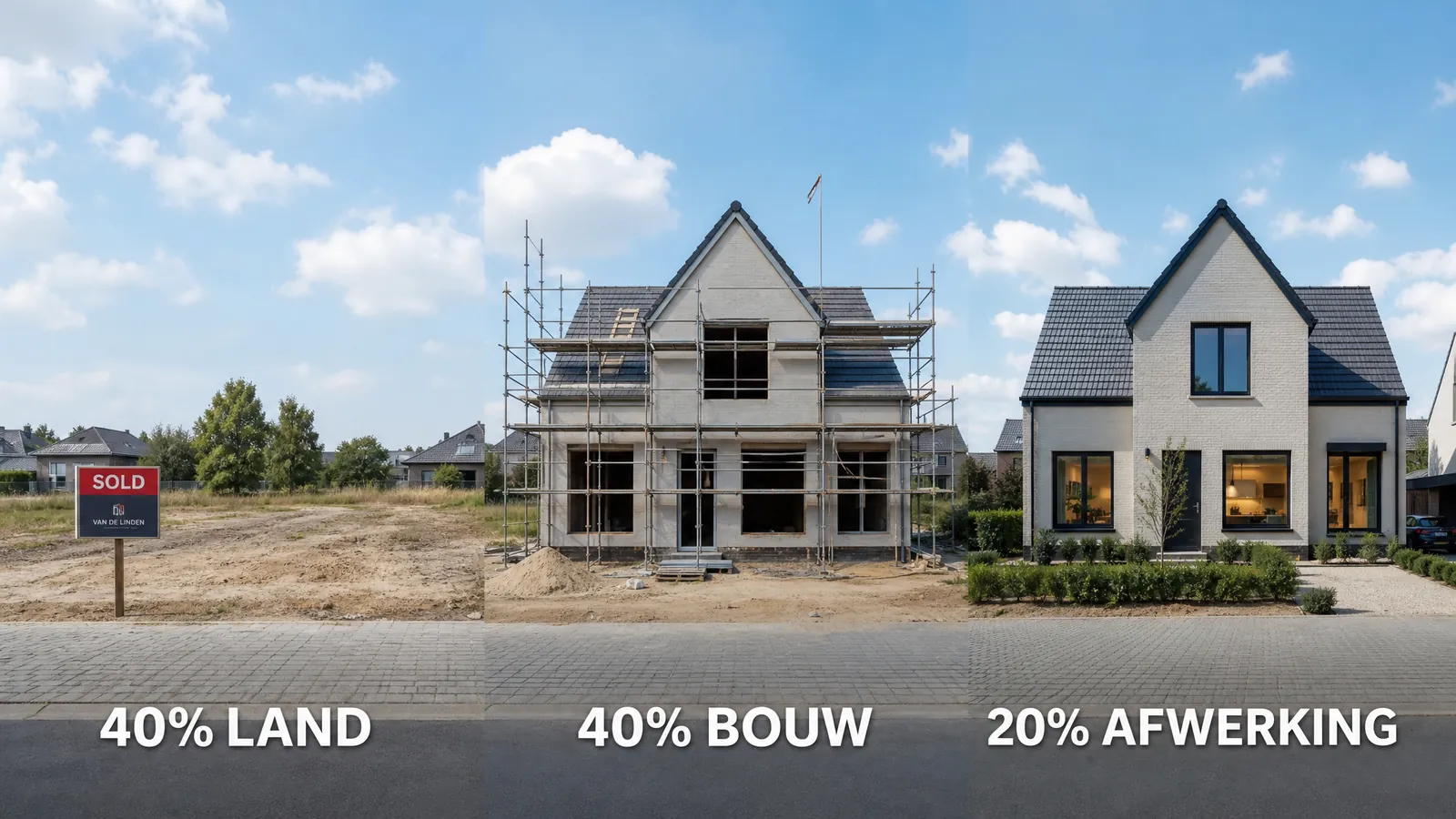
A nieuwbouw mortgage covers the total cost of your home: the land it sits on, the construction of the building, and the meerwerk and finishing you've added. For most houses, the rough breakdown looks like this:
~40%
Land
Paid in full on notary day, directly from your mortgage. From that moment, you're paying full interest on it.
~40%
Construction
Held in your bouwdepot. Released in stages to the contractor as termijnbetalingen — typically 5 to 8 phases.
For apartments the ratio shifts — land is shared across many units, so per-buyer land cost is much lower and the bouwdepot is proportionally bigger. But the principle is the same: your mortgage isn't sitting in one place doing one thing. It's three flows, moving at different speeds, on different timelines.
Your monthly payment grows for two years
The day you sign at the notary, the land portion of your mortgage activates. You start paying mortgage interest on that portion immediately. The rest of your mortgage — roughly half — sits in the bouwdepot, untouched.
Here's the part most buyers don't know: most banks credit you interest on the depot balance at approximately the same rate you pay on the mortgage. So during the first months after notary day, the interest you pay on the full mortgage is largely offset by the interest you receive on the undrawn depot. Net cost? Mostly the land portion.
Then construction starts. Every time a phase completes, the contractor invoices you. The bank pays the invoice from the depot. The depot shrinks. The interest credit shrinks with it. Your net monthly mortgage cost rises.
By the time you collect your keys, the depot is empty. There's no offsetting interest credit anymore. You're paying full interest on the full mortgage. The number on your final statement might be twice what it was on your first.
This isn't renteverlies in some punitive sense — it's the simple mechanics of paying interest on money as it actually moves into your house. But buyers who budget for "the monthly payment" without realising it's a moving target get caught off-guard, often around month nine or ten when the rise becomes obvious.
The squeeze that decides whether the whole thing is survivable
The rising mortgage payment isn't the biggest financial pressure during construction. The biggest pressure is that your old housing costs haven't gone away.
For eighteen to twenty-four months, you're paying twice. Rent on your current place plus the new mortgage. Or the old mortgage plus the new one. Or some combination of overlapping costs that make every month feel like double rent.
This is the squeeze that decides whether the whole project is financially survivable. For some buyers it's manageable. For others — especially first-time buyers without significant savings — it can be a deal-breaker. The good news: there are three ways to handle it, and most buyers only hear about one of them.
1
Pay from savings
The default. You carry both housing costs out of pocket for the duration. Banks will stress-test that you can sustain this for up to two years before approving the mortgage. If your savings won't support it, this option is closed.
2
Overbruggingshypotheek
A bridging loan secured against the overwaarde in your existing home, if you own. Lets you free up equity to cover double costs without selling immediately. Available to homeowners only, with a real overwaarde.
3
Meefinancieren — fold double costs into the mortgage itself
Most banks will let you add the projected double-housing costs to the mortgage amount. Your total loan goes up, your monthly cash flow during construction becomes manageable, and the fiscal treatment is often favourable. For some buyers, this is the difference between affordable and impossible.
Option 3 is rarely the first thing a mortgage advisor explains. It's worth asking about explicitly — especially if option 1 looks tight on paper.
The mortgage offer has a three-month clock
Hypotheekoffertes in the Netherlands are typically valid for three months. With nieuwbouw, the gap between getting your offer and actually signing the hypotheekakte at the notary is often longer than that — construction timelines slip, opschortende voorwaarden take time to lift, and your offer can expire while you wait.
Extending an expired offer means paying a bereidstellingsprovisie — a fee to keep your offered rate valid for additional months. Predictable, common, and almost never budgeted. Worth asking your advisor for the specific fee on your offer before you sign anything.
Bouwrente — only when timing slips
If construction begins before your mortgage is in place at the notary, the contractor charges interest on the land plus any completed phases. This is bouwrente — compensation for the contractor floating costs that should already be yours. Rates typically run 4–8% annually.
For most buyers who time their mortgage to coincide with notary day, bouwrente is minimal or zero. For buyers whose mortgage isn't ready when the developer wants to start, or who buy late into a project where construction is already underway, it can add up to a real number. It appears on the final notarial closing statement. Worth knowing the exact percentage your contractor charges before that day arrives.
What the bouwdepot pays for — and what it doesn't
The bouwdepot covers things attached to your home:
- Kitchen, bathroom, fixed flooring (glued or built-in)
- Garden, terraces, fences
- Built-in storage, fitted lighting, fitted blinds
- Stucwerk, painting, wallpaper
- Insulation, solar panels, heat pumps
It does not cover:
- Loose carpets and rugs, curtains
- Freestanding furniture, appliances (some lenders allow built-in ovens, not freestanding fridges)
- Tools, paint brushes, anything you'll take with you if you move
Term limit: typically two to three years for nieuwbouw, depending on the lender. After that, unused balance is usually applied as mortgage repayment. Money you intended to spend on the home can effectively disappear if you don't claim it in time.
What helps
A mortgage advisor who walks you through the rising payment curve, not just the maximum borrowing capacity. A budget that names bereidstellingsprovisie, double housing costs, and potential bouwrente as line items rather than surprises. A clear decision early on whether to meefinancieren double costs — that one choice changes the entire shape of your construction period.
Most of this gets covered in a single ninety-minute meeting on a Wednesday afternoon. Then the buyer leaves with thirty pages of documentation and remembers about a third of it.
The complexity isn't the problem
A nieuwbouw mortgage isn't more complex than a regular one. It's complex differently — and the complexity hits in the months after signing, not on the day of.
The number on your first statement isn't the number on your statement eighteen months later. The savings you walked in with aren't the savings you'll walk out with. The advisor who maxed out your borrowing capacity wasn't lying about what you could afford, but they were answering a smaller question than the one you needed answered.
The buyers who feel calm during construction are the ones who saw the full picture — the rising payments, the double-housing math, the bouwdepot rules — before they signed. Not after.
IZIKEY walks you through all of it. Not just what you can borrow, but how the money will actually move once you have.
Home, simplified.
IZIKEY guides you from reservation to keys: a dashboard for your purchase, and Kay to answer your questions, in Dutch or English.
Start your free trial
More about IZIKEY
De meeste kopers verlaten het kantoor van de hypotheekadviseur met één getal in hun hoofd: de maandlast. Logisch. Dat is het bedrag dat je elke maand daadwerkelijk moet betalen. Al het andere is detail.
Maar bij nieuwbouw is dat maandbedrag geen maandbedrag. Het is een startbedrag. Het stijgt elk kwartaal naarmate de bouw vordert, en stabiliseert pas achttien tot vierentwintig maanden later — als je huis klaar is en je er bent ingetrokken.
Dat is geen probleem met de hypotheek. Zo werkt nieuwbouwfinanciering. Het probleem is dat bijna niemand het zo uitlegt.
Je hypotheek is drie geldstromen, niet één getal
Een nieuwbouwhypotheek dekt de totale kosten van je woning: de grond, de bouw en het meerwerk en de afwerking die je hebt toegevoegd. Voor de meeste woningen ziet de globale verdeling er zo uit:
~40%
Grond
Volledig betaald op de dag van de notariële akte, direct uit je hypotheek. Vanaf dat moment betaal je volledig rente over dit deel.
~40%
Bouw
In je bouwdepot. Vrijgegeven in termijnen aan de aannemer als termijnbetalingen — doorgaans 5 tot 8 fases.
Voor appartementen verschuift de verdeling — grond is verdeeld over veel eenheden, dus de grondkosten per koper zijn lager en het bouwdepot is proportioneel groter. Maar het principe is hetzelfde: je hypotheek staat niet op één plek met één doel. Het zijn drie geldstromen, op drie verschillende tijdlijnen.
Je maandlast stijgt twee jaar lang
Op de dag van de notariële akte wordt het gronddeel van je hypotheek actief. Je begint direct rente te betalen over dat deel. De rest van je hypotheek — circa de helft — staat in het bouwdepot, onaangeroerd.
Hier is wat de meeste kopers niet weten: de meeste banken vergoeden rente over het depotsaldo tegen ongeveer hetzelfde tarief als wat je over de hypotheek betaalt. In de eerste maanden na de notarisdag wordt de rente over de volledige hypotheek dus grotendeels gecompenseerd door de rentevergoeding op het niet-opgenomen depot. Nettolast? Voornamelijk het gronddeel.
Dan begint de bouw. Zodra een fase klaar is, factureert de aannemer. De bank betaalt de factuur vanuit het depot. Het depot krimpt. De rentevergoeding krimpt mee. Je netto maandlast stijgt.
Tegen de tijd dat je de sleutels krijgt, is het depot leeg. Er is geen compenserende rentevergoeding meer. Je betaalt volledig rente over de volledige hypotheek. Het bedrag op je laatste afschrift kan twee keer zo hoog zijn als op je eerste.
Dit is niet renteverlies in een punitieve zin — het zijn gewoon de mechanismen van rente betalen over geld naarmate het daadwerkelijk in je huis stroomt. Maar kopers die budgetteren op 'de maandlast' zonder te beseffen dat dit een bewegend doel is, worden verrast — vaak rond maand negen of tien als de stijging merkbaar wordt.
De squeeze die bepaalt of het hele project haalbaar is
De stijgende maandlast is niet de grootste financiële druk tijdens de bouw. De grootste druk is dat je oude woonlasten niet zijn verdwenen.
Achttien tot vierentwintig maanden betaal je dubbel. Huur bij je huidige woning plus de nieuwe hypotheek. Of de oude hypotheek plus de nieuwe. Of een combinatie van overlappende kosten die elke maand voelt als dubbele huur.
Dit is de squeeze die bepaalt of het hele project financieel haalbaar is. Voor sommige kopers is het te dragen. Voor anderen — zeker voor starters zonder flinke spaarbuffers — kan het een dealbreaker zijn. Het goede nieuws: er zijn drie manieren om dit op te lossen, en de meeste kopers horen er maar één.
1
Betalen vanuit spaargeld
De standaard. Je draagt beide woonlasten zelf, gedurende de bouwtijd. Banken toetsen of je dit twee jaar kunt volhouden voordat ze de hypotheek goedkeuren. Als je spaargeld dit niet aankan, is deze optie gesloten.
2
Overbruggingshypotheek
Een overbruggingskrediet op de overwaarde van je huidige woning, als je eigenaar bent. Hiermee kun je eigen vermogen vrijmaken voor dubbele lasten zonder direct te verkopen. Alleen beschikbaar voor eigenaren met een reële overwaarde.
3
Meefinancieren — dubbele lasten in de hypotheek opnemen
De meeste banken staan toe dat je de geraamde dubbele woonlasten aan het hypotheekbedrag toevoegt. Je totale lening gaat omhoog, je maandelijkse cashflow tijdens de bouw wordt beheersbaar, en de fiscale behandeling is vaak gunstig. Voor sommige kopers is dit het verschil tussen betaalbaar en onmogelijk.
Optie 3 is zelden het eerste wat een hypotheekadviseur uitlegt. Het is de moeite waard om er expliciet naar te vragen — zeker als optie 1 krap uitpakt op papier.
De hypotheekofferte heeft een klok van drie maanden
Hypotheekoffertes in Nederland zijn doorgaans drie maanden geldig. Bij nieuwbouw is de kloof tussen het ontvangen van de offerte en het daadwerkelijk tekenen van de hypotheekakte bij de notaris vaak groter — bouwtijdlijnen lopen uit, opschortende voorwaarden kosten tijd, en je offerte kan verlopen terwijl je wacht.
Een verlopen offerte verlengen kost een bereidstellingsprovisie — een vergoeding om je aangeboden rente nog een aantal maanden geldig te houden. Voorspelbaar, gangbaar en bijna nooit begroot. Vraag je adviseur om het exacte bedrag voor jouw offerte voordat je iets tekent.
Bouwrente — alleen als de timing uitloopt
Als de bouw begint vóórdat je hypotheek bij de notaris is geregeld, berekent de aannemer rente over de grond plus eventueel afgeronde fases. Dit is bouwrente — een vergoeding voor de aannemer die kosten voorschiet die al van jou hadden moeten zijn. Tarieven liggen doorgaans op 4–8% per jaar.
Voor de meeste kopers die hun hypotheek laten samenvallen met de notarisdag is bouwrente minimaal of nul. Voor kopers wier hypotheek niet klaar is als de ontwikkelaar wil starten, of die laat in een project instappen waarbij de bouw al loopt, kan het een echt getal worden. Het staat op de definitieve notariële afrekening. Het loont om het exacte percentage bij je aannemer op te vragen vóór die dag.
Wat het bouwdepot dekt — en wat niet
Het bouwdepot dekt zaken die aan je woning zijn verbonden:
- Keuken, badkamer, vaste vloerbedekking (gelijmd of ingebouwd)
- Tuin, terrassen, schuttingen
- Inbouwkasten, vaste verlichting, vaste zonwering
- Stucwerk, schilderen, behang
- Isolatie, zonnepanelen, warmtepompen
Het dekt niet:
- Losse vloerkleden en gordijnen
- Losstaand meubilair, apparatuur (sommige geldverstrekkers staan ingebouwde ovens toe, niet losstaande koelkasten)
- Gereedschap, verfkwasten, alles wat je meeneemt bij een verhuizing
Looptijd: doorgaans twee tot drie jaar voor nieuwbouw, afhankelijk van de geldverstrekker. Daarna wordt het ongebruikte saldo doorgaans verrekend als hypotheekaflossing. Geld dat je voor de woning had willen gebruiken kan effectief verdwijnen als je het niet op tijd opvraagt.
Wat helpt
Een hypotheekadviseur die je de stijgende lastencurve uitlegt — niet alleen de maximale leencapaciteit. Een begroting die bereidstellingsprovisie, dubbele woonlasten en eventuele bouwrente als regels benoemt in plaats van als verrassingen. Een vroege beslissing over meefinancieren — die ene keuze verandert de hele financiële structuur van je bouwperiode.
Het meeste hiervan komt aan bod in één gesprek van anderhalf uur op een woensdagmiddag. Dan vertrekt de koper met dertig pagina's documentatie en onthoudt een derde ervan.
De complexiteit is niet het probleem
Een nieuwbouwhypotheek is niet complexer dan een gewone hypotheek. Ze is complex op een andere manier — en die complexiteit slaat toe in de maanden ná het tekenen, niet op de dag zelf.
Het getal op je eerste afschrift is niet het getal op je afschrift achttien maanden later. Het spaargeld waarmee je erin ging is niet het spaargeld waarmee je eruit komt. De adviseur die je leencapaciteit maximaliseerde loog niet over wat je kon betalen, maar beantwoordde een kleinere vraag dan de vraag die je eigenlijk nodig had.
De kopers die rustig blijven tijdens de bouw zijn degenen die het volledige beeld zagen — de stijgende lasten, de dubbele-woonlasten-rekening, de bouwdepotregels — vóórdat ze tekenden. Niet erna.
IZIKEY begeleidt je door het geheel. Niet alleen wat je kunt lenen, maar ook hoe het geld daadwerkelijk gaat bewegen als je het eenmaal hebt.
Home, simplified.
IZIKEY begeleidt je van reservering tot sleutel: een dashboard voor je koop, en Kay om al je vragen te beantwoorden, in het Nederlands of Engels.
Start je gratis proefperiode
Meer over IZIKEY